20.2 per cent
Adults in England with a common mental health condition. The most common named one is generalised anxiety disorder, at 7.5 per cent.
NHS England, Adult Psychiatric Morbidity Survey 2023/4
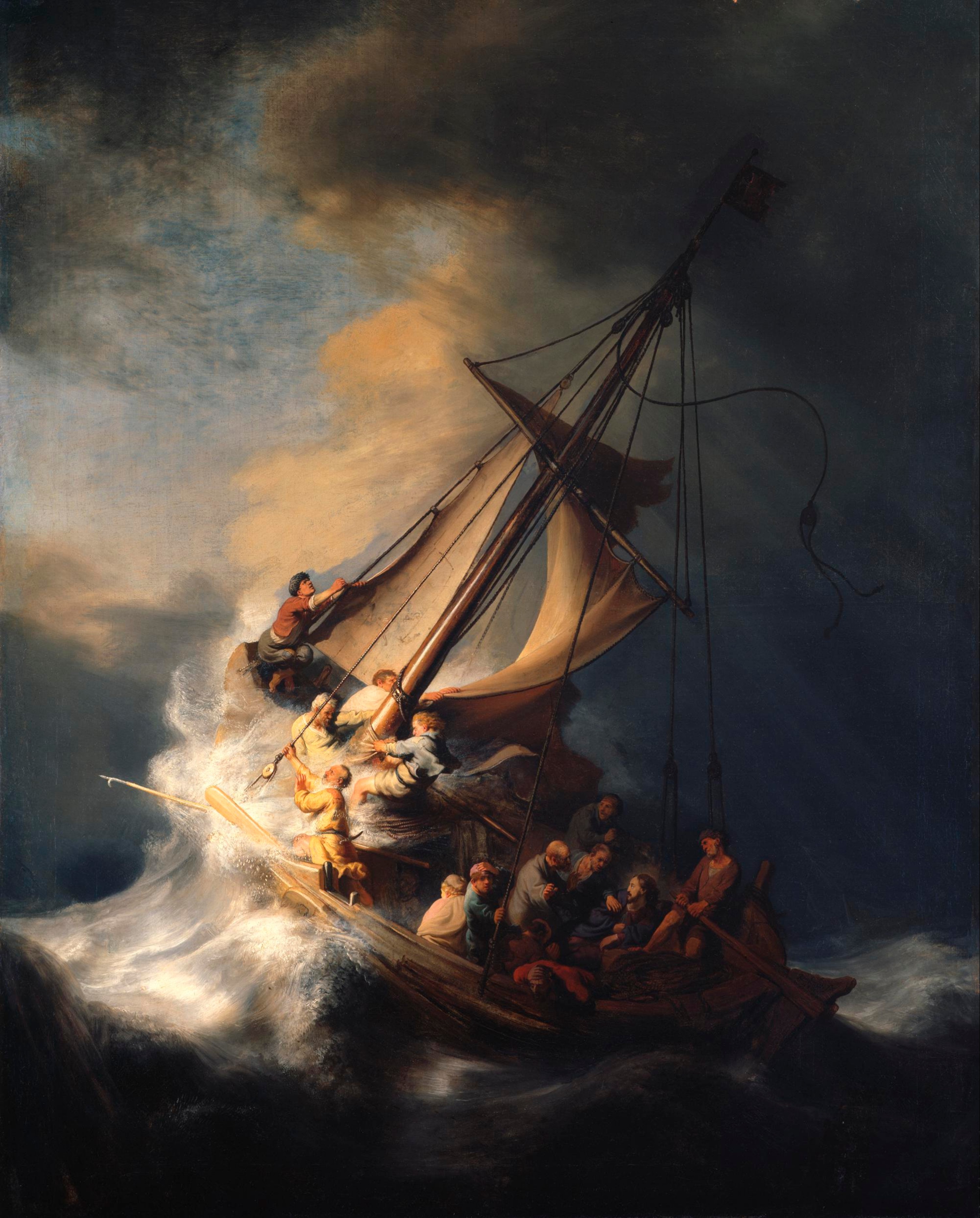
On fear, underestimating and doubt
The voice that says you cannot sounds like knowledge. It is a forecast, and the evidence shows it often goes wrong, in predictable ways. With every figure sourced.
Rembrandt · 1633
From the editor
You may know the voice. It speaks before the interview, the phone call, the first day back, the message drafted nine times and never sent.
It says the thing will go badly. It says you are not up to it, and that people will see through you. It speaks in the present tense and with total confidence, so it sounds like knowledge. It is a forecast, and forecasts can be checked.
In business, FUD, short for fear, uncertainty and doubt, is the name given to selling by spreading worry about the alternative. The phrase itself is older. The earliest use we could find is in a letter written in Georgia, in the United States, in 1917, which called suspicion “a sign of fear, uncertainty and doubt”. This issue changes one word. Fear, underestimating and doubt.
Then it checks each against the evidence. How often anxious worries come true. Whether other people are as unwilling as the voice predicts. Whether we judge our own ability too harshly, or too kindly. Where the famous figures about worry and impostor syndrome came from. And what a person in this country can ask for when fear has started to run the day.
The answer is not that fear is always wrong. Anxiety in this country is real, measured and more common than it was, and some fears come true. The answer is that the voice goes wrong in predictable directions, and a forecast that keeps going wrong the same way deserves to be checked before it is obeyed.
This company was started by people who met inside the mental health system. We have no wish to make fear sound small.
Every figure here is sourced, dated and named. Where a number could not be traced to the body that published it, it is not printed as fact, and the last page says what was left out.
What this issue is not. It is not a pep talk, and it is not a promise that the thing you dread will not happen. It is a check on the forecasts, and a list of what can be asked for.
01 · Fear
The country measures its anxiety every quarter by asking one plain question about the day before: overall, how anxious did you feel yesterday?
23.8 per cent
Adults in the UK who scored their anxiety yesterday at 6 or more out of 10, in January to March 2026. In the same months of 2019 the figure was 20.5 per cent, though the series has risen and fallen since it began in 2011. The average score was 3.3.
Office for National Statistics, Quarterly personal well-being estimates, non-seasonally adjusted, April 2011 to March 2026, released 28 August 2026. Annual Population Survey, people aged 16 and over.
Other official measures show a clearer rise. The Office for National Statistics reported in June 2026 that in 2023 and 2024, 24.6 per cent of adults in the UK showed some evidence of depression or anxiety on a standard questionnaire, up from 19.7 per cent in 2018 to 2019.
7.5 per cent
Adults in England with generalised anxiety disorder in the past week, the most common of the named conditions in England's official survey of adult mental health. One adult in five, 20.2 per cent, had a common mental health condition of some kind: 24.2 per cent of women and 15.4 per cent of men.
NHS England, Adult Psychiatric Morbidity Survey: Survey of Mental Health and Wellbeing, England, 2023/4, published 2025. Adults aged 16 and over; fieldwork March 2023 to July 2024.
Nearly doubled
Generalised anxiety disorder among 16 to 64 year olds in England: 4.4 per cent in 1993, still 4.7 per cent in 2007, then 6.6 per cent in 2014 and 8.5 per cent in 2023/4. Among 16 to 24 year olds it rose from 1.1 per cent in 2000 to 7.6 per cent, though that last figure carries a wide margin of error.
NHS England, Adult Psychiatric Morbidity Survey 2023/4, Chapter 1, Common mental health conditions.
The same survey found that most people living with some forms of anxiety have never been told so. Of adults it identified with a phobia, 12.5 per cent said they had ever had one, and 3.3 per cent had ever received a professional diagnosis. For obsessive compulsive disorder the diagnosed share was 9.6 per cent. Many of them, though, had been diagnosed with depression.
Children carry it too. In October 2025 the NSPCC reported that Childline counsellors had delivered 12,543 sessions about anxiety in the past year, the most common mental health concern that children bring to the service.
58 per cent
Of adults aged 18 to 64 in the UK who saw a good chance to start a business but were not already starting or running one, the share who said in 2024 that fear of failure would stop them. It was the highest since the UK figures began in 2002, and had sat just under 40 per cent until 2011. In 2025 it fell back to just under half.
Global Entrepreneurship Monitor, United Kingdom 2024/2025 National Report, 2025; GEM economy profile, United Kingdom, 2025 data.
02 · The worry
A widely shared line about worry says that 85 per cent of what we worry about never happens, and credits it to a study at Cornell. We went looking for the study.
91.4 per cent
Worries that did not come true, in a 2020 study that tracked them. Twenty nine university students who met the criteria for generalised anxiety disorder on a standard questionnaire logged their worries when prompted, four times a day for ten days, and tracked what happened over 30 days. For seven of the 29, not one worry came true.
LaFreniere, L.S. and Newman, M.G., Exposing Worry's Deceit: Percentage of Untrue Worries in Generalized Anxiety Disorder Treatment, Behavior Therapy 51(3), 2020.
The students' gut feeling put the chance of a worry coming true at 62 per cent on average, and even their careful, reasoned estimates said 42 per cent. The real rate was 8.6 per cent.
The famous number matches results from 1999, described in a single paragraph. The psychologist T.D. Borkovec and colleagues mentioned, in passing, that 17 clients in treatment had rated 85 per cent of their worries as turning out “better than expected”. Whether that meant the worries never happened is not clear: the researchers behind the 91 per cent study describe it both ways. The second number in the popular version comes from the same paragraph: when worries did not turn out better, the clients coped better than expected 79 per cent of the time.
Those researchers add that the reports were not peer reviewed and gave few details. We found no Cornell study anywhere in the chain.
30 per cent
Of the worries that did come true, the share that turned out better than the student expected. 44 per cent were as bad as expected, and 26 per cent worse.
LaFreniere and Newman, Behavior Therapy 51(3), 2020, Table 1.
So the honest version is narrower, and still worth having. In the study we found, of students whose worry had become a disorder, most of what they dreaded did not happen, their forecasts ran several times too high, and when the bad thing did come it was often no worse than they feared. It is one study of 29 students. It is not a law about everyone.
None of this means people always expect the worst. When people judge their own risk of ordinary misfortunes, a small study at University College London in 2011 found they took good news on board more readily than bad, though a paper from Cardiff University the same year questions whether people are unrealistically optimistic about their own risk at all. Which way a forecast goes wrong depends on what it is about. That is the reason to check each one.
Their forecasts ran several times too high.
03 · Underestimating
Fear makes forecasts about other people too: that they will not want to talk, will not want to help, will find us dull. Researchers have tested those forecasts again and again.
4.30 against 3.61
After about five minutes talking to a stranger at workshops in the UK, people rated their partner as more interesting than they guessed their partner had rated them: 4.30 against 3.61, on the same scale. The researchers call it the liking gap: across their studies, people thought they were liked less than they were.
Boothby, E.J., Cooney, G., Sandstrom, G.M. and Clark, M.S., The Liking Gap in Conversations, Psychological Science 29(11), 2018. Study 4: members of the public at How to Talk to Strangers workshops in the UK.
383 commuters
Travellers recruited at Liverpool Street, Cambridge, Chelmsford and Colchester stations. Those asked to talk to a stranger on the train had a better commute than those asked to keep to themselves. In a second study at the same stations, commuters expected that trying to start a conversation would be less pleasant than having one, because they assumed others would not want to talk.
Schroeder, J., Lyons, D. and Epley, N., Hello, stranger? Pleasant conversations are preceded by concerns about starting one, Journal of Experimental Psychology: General 151(5), 2022.
20.5 against 10.5
How many strangers students in New York expected to ask before five agreed to fill in a questionnaire, against how many they actually had to ask. They expected to need about twice as many as they did.
Flynn, F.J. and Lake, V.K.B., If You Need Help, Just Ask: Underestimating Compliance With Direct Requests for Help, Journal of Personality and Social Psychology 95(1), 2008.
Studies published in 2022 by Xuan Zhao and Nicholas Epley, with 2,118 adults in the United States, found that people who needed help underrated how willing others were and how good helping would make them feel, though not on every measure.
7.88 against 6.01
How surprised people were, out of 10, to receive a letter of thanks, against how surprised the writers expected them to be. The writers also expected the moment to be more awkward than it was. Business students in the United States.
Kumar, A. and Epley, N., Undervaluing Gratitude: Expressers Misunderstand the Consequences of Showing Appreciation, Psychological Science 29(9), 2018.
Small kindness follows the same pattern. In a study published in 2023, people in a Chicago park who gave away a cup of hot chocolate rated the size of the gesture at 3.76 out of 10. The people who received it rated it 7.00.
Most of these studies were done in the United States, and two of the results above come from the UK. Almost all of them point the same way. The fear lives in the asking, and the asking usually goes better than the fear predicted.
04 · Doubt
The best known study of self judgement is usually told as a story about fools who think they are clever. It is also a story about the people at the top, who thought they were merely good.
86th, guessed 68th
Where the top quarter of students actually scored on a logic test, as a percentile of their class, against where they placed themselves. On grammar it was the 89th against the 70th. The bottom quarter, on average, scored in the 12th percentile and placed themselves in the 62nd.
Kruger, J. and Dunning, D., Unskilled and Unaware of It, Journal of Personality and Social Psychology 77(6), 1999. Undergraduates at Cornell University.
The researchers had a plain explanation for the top quarter's modesty. Those students assumed everyone else had found the test as easy as they had, and when they were shown other people's answers, they raised their estimates. Their modesty was a wrong guess about other people, the same kind of mistake the commuters made.
The famous chart is not in the paper. The curve of confidence that climbs, crashes and slowly recovers, widely shared as the Dunning-Kruger effect, appears nowhere in it: the paper's charts plot four groups by test score, with no time or experience on either axis.
Impostor syndrome began as something two psychologists noticed. In 1978 Pauline Clance and Suzanne Imes, in Atlanta, described what they had seen in more than 150 high achieving women in therapy, groups and classes: “an internal experience of intellectual phoniness”. They called it the impostor phenomenon. It was a clinical observation, and it measured no rate.
9 to 82 per cent
The range of impostor syndrome rates found across 62 studies of 14,161 people, depending largely on which questionnaire was used and where its line was drawn. In one study the same group gave 24 or 39 per cent, depending only on the cut off. The review found no published study testing a treatment.
Bravata, D.M. et al., Prevalence, Predictors, and Treatment of Impostor Syndrome: a Systematic Review, Journal of General Internal Medicine 35(4), 2020.
The line that 70 per cent of people will feel like an impostor at some point in their lives leads back to a 2007 news article in the Chronicle of Higher Education. It reported a survey from the mid 1980s by Pauline Clance and Gail Matthews, which found that about 70 per cent had felt like impostors “for at least some part of their careers”. By 2011 a review had turned “some part of their careers” into a whole lifetime. We found no published survey behind it.
The newest pooled estimate, published in 2026, covers medical students: 49 per cent across 34 studies of 9,550 students, 51 per cent of women and 40 per cent of men. Its authors warn that the studies disagree widely and rely on unvalidated cut offs, which weakens the figure.
Clance and Imes thought the feeling was much rarer in men. Later research is split. Of the 33 articles in the 2020 review that compared the sexes, 16 found that women reported significantly more impostor feelings, and 17 found no difference.
Another widely repeated figure about doubt has no published evidence behind it. The claim that men apply for a job when they meet 60 per cent of the criteria, and women only when they meet 100 per cent, is credited to an internal Hewlett-Packard report, and we found no published version of it.
Impostor syndrome is not a diagnosis either. It has no entry in the World Health Organization's international classification of diseases, and the 2020 review says plainly that it “is not a recognized psychiatric disorder”. The feeling is real. The famous number is not a published finding.
“Our doubts are traitors, / And make us lose the good we oft might win / By fearing to attempt.”
“It would be interesting to know what it is men are most afraid of. Taking a new step, uttering a new word is what they fear most.”
“He hath heart who knoweth fear, but vanquisheth it; who seeth the abyss, but with pride.”
The road in
Each number counts something different: the survey counts people, the service counts referrals, and the years differ.
05 · Treatment
The good news is in the NHS's own figures for England, and so is the catch.
57.4 per cent
Recovery among people who finished a course of NHS Talking Therapies for generalised anxiety disorder in 2025 to 2026. For specific phobias it was 65.9 per cent, panic disorder 50.6, social anxiety 37.5 and agoraphobia 34.8.
NHS England, NHS Talking Therapies, for anxiety and depression, Annual report 2025 to 2026, published 24 September 2026. England; courses of at least two treatment sessions.
Social anxiety and agoraphobia recover least often, but 69.5 per cent of the people who finished treatment for social anxiety still showed reliable improvement. Its courses also run longer: 11 sessions on average, against 7.8 for generalised anxiety.
68.7 days
The average wait between the first appointment and the second, for courses that finished in 2025 to 2026. 23.8 per cent waited more than 90 days. The national six week target stops the clock at the first appointment, which the service's own manual says is primarily assessment.
NHS England, NHS Talking Therapies annual report 2025 to 2026. NHS Talking Therapies for anxiety and depression Manual, version 7, updated March 2024.
At any one time, many people are getting no treatment at all. In the national survey, 44.6 per cent of adults in England with a common mental health condition were receiving medication or a psychological therapy when they were interviewed, so more than half were receiving neither. Support from a GP alone is not counted.
06 · What can be asked for
Fear is good at one thing above all: keeping a person from asking. So here is what can be asked for, and by whom, starting tomorrow morning.
The voice will not go away, and it should not, because some of what it warns about is real. It is wrong more often than it sounds, and in the same places: about the worry that will not come true, the stranger who would be glad to talk, the person who would be glad to help, and, for people who are good at something, where they stand.
These lines are open now. They are free, they are answered by people, and you do not have to be in danger to use one. Fear that will not settle at three in the morning is reason enough to call.