On the hours nobody staffs
The offices close, the phones divert, the appointment is in eleven days. The mind keeps its own hours, and it does not observe ours. With every figure sourced.
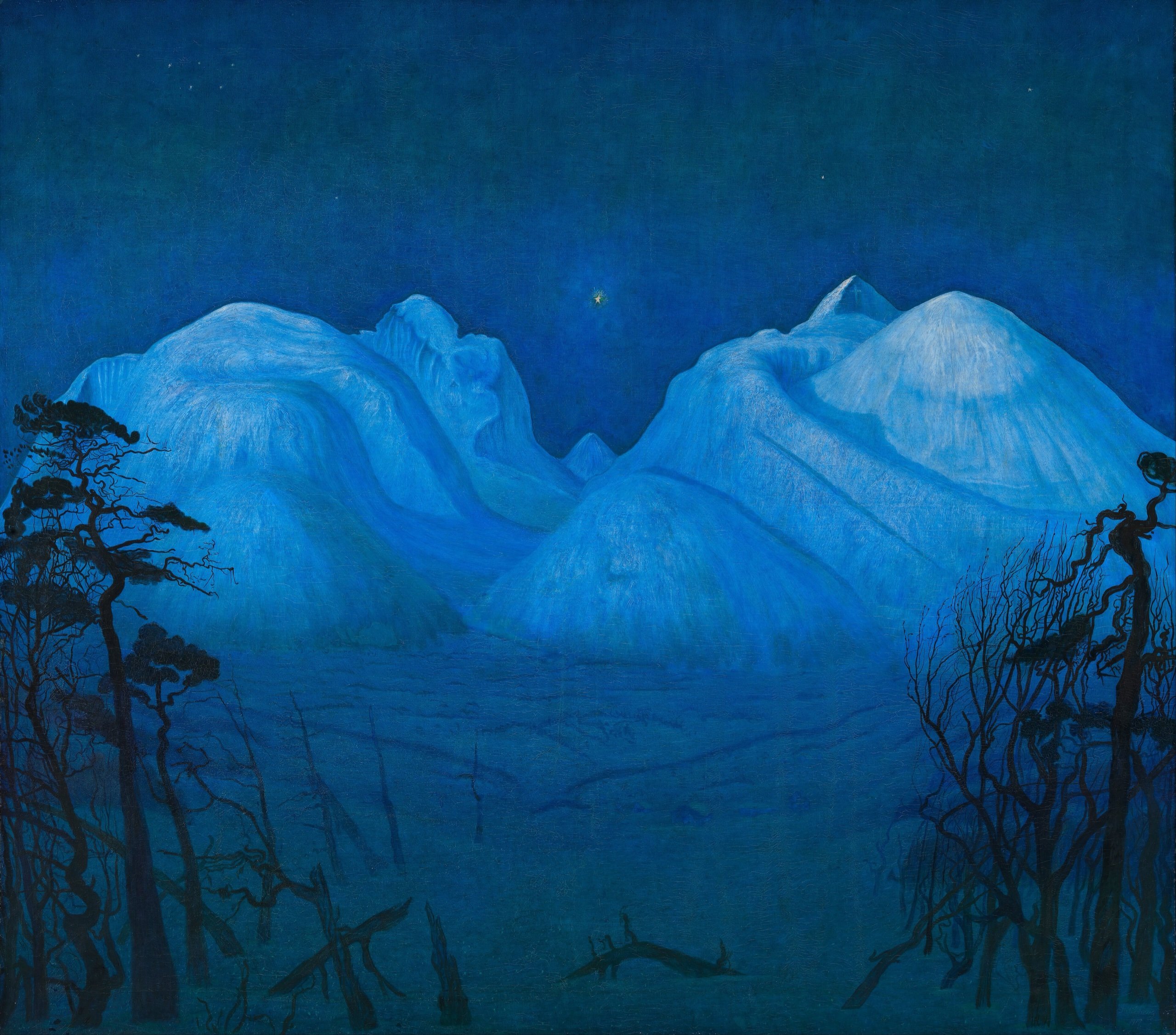
Sohlberg · 1914
From the Editor
Somewhere near you there is a building with a mental health service inside it. Tonight, at about five o'clock, the last person in it will put on a coat, set an answerphone, and go home to their own family. This is not a scandal. It is a working day ending, the way working days do.
The difficulty is that nothing inside the people on that service's list ends at the same time.
This issue is about the hours after that door closes. Not the drama of them. The arithmetic of them: what is actually open, what is actually known, and what happens in the specific, unglamorous stretch between the last bus and the first light, when a person is awake and the institutions that exist for them are not.
Our last issue argued that a mood disorder is a swing nobody bought a ticket for, and that what decides its damage is whether anyone notices. This one narrows to the hardest case of that argument. At two in the afternoon, noticing is possible. There are colleagues, receptionists, a number that gets answered. At four in the morning there is a ceiling, a phone, and whatever a person has already been told to do.
I want to be careful here, because this subject attracts a particular kind of writing. There is a familiar paragraph about the terror of three in the morning, and it is usually built out of atmosphere rather than evidence. We went looking for the evidence instead, and the first thing we found was that the most repeated claim in the entire field is wrong.
So this issue does what the last one did. It argues, and it shows its working. Every figure carries the body that published it, the period it covers and the population it describes. Where a number everybody repeats turned out to be untraceable, or true of a different country, or true only after an adjustment nobody mentions, we have said so and left it out. There is a list of those at the back. It is longer than the list of things we could prove.
That is not a weakness in the reporting. It is the finding.
01 · The Hour Nobody Counts
You will have read that suicides peak at three in the morning. It is in the features, the podcasts and the awareness copy. It is not true, and the way it became untrue is worth more than the claim ever was.
Start with the harder problem underneath it. In this country we do not know what time people die by suicide, because nobody writes it down.
Not recorded
Asked directly for suicides by time of day, the Office for National Statistics answered that time of death is not recorded on the death certificate. There is no national United Kingdom figure for what hour these deaths happen, and the annual report of the National Confidential Inquiry does not contain one either.
Office for National Statistics, freedom of information response, 11 December 2020
Hold that for a moment, because it has a consequence. Any British statistic you have ever seen about suicide and the small hours was not derived from British national data, for the simple reason that the data does not exist. It came from somewhere else, and usually from the United States.
What the American data shows is genuinely striking, and it is not what the headline says. Researchers took nearly eighty thousand suicides and asked a better question than the usual one. Not how many happened at each hour, but how much risk each waking hour carried, once you account for the fact that almost everyone is asleep at three in the morning and almost nobody is asleep at noon.
5.20 times
Adjusted for how many people were awake, the risk of suicide at three in the morning was 5.20 times the twenty four hour average, with a confidence interval of 4.74 to 5.70. Homicide peaked at two in the morning at 8.04 times. The study covered 78,647 suicides across thirty five states between 2003 and 2017.
Tubbs and colleagues, Journal of Clinical Psychiatry, May 2024
And now the sentence that almost never travels with it.
Noon
In the same dataset, the raw number of suicides peaked at twelve o'clock in the day. The night is not when most of these deaths happen. It is when each waking hour carries the most risk. Those are different claims, and only the second one survives contact with the figures.
Tubbs and colleagues, Journal of Clinical Psychiatry, May 2024
This matters beyond pedantry. A service planner reading the popular version moves resources to the hours with the highest counts and concludes the night is quiet. A service planner reading the actual finding understands that the night is thin: fewer people awake, each of them at considerably higher risk, and almost nothing open.
Where Britain does keep records, they point the same way. The largest study of self harm presentations in English hospitals looked at more than ten thousand episodes across Oxford, Manchester and Leeds and found the commonest time of arrival was between ten at night and two in the morning. The data is from 2000 and 2001, which we state plainly because it is old, and because nobody has published a better British series since.
10pm to 2am
The most common time of presentation to hospital for self harm, across 10,498 episodes involving 7,344 people in three English cities. Internationally the picture repeats: of twenty two studies, twenty found that self harm presentations fall outside Monday to Friday, nine to five, and cluster in the hours either side of midnight.
Hawton and colleagues, Social Psychiatry and Psychiatric Epidemiology, 2007; Mc Evoy, Clarke and Joyce, same journal, 2023
So the demand is nocturnal, the risk per waking hour is nocturnal, and the provision, as the next pages show, is not.
02 · What the Night Actually Does
The folk explanation for why four in the morning feels worse is that you are tired. The evidence says something stranger and more precise: the hour itself is doing some of the work, independently of how long you have been awake.
This was established by an experiment with an unpleasant premise. Volunteers were put on schedules of twenty eight and thirty hours, long enough that their body clocks came loose from the clock on the wall, so that the researchers could separate two things that ordinarily move together: how long a person has been awake, and where they are in their own circadian cycle.
Phase, not fatigue
Across twenty four healthy subjects, mood varied significantly with circadian phase. There was no reliable main effect of how long the person had been awake. The hour of the internal clock predicted how they felt; the accumulated tiredness, on its own, did not.
Boivin and colleagues, Archives of General Psychiatry, 1997
That is the honest core of the thing, and it is enough. It says the feeling arriving at four in the morning is not a failure of character or a lapse in perspective. It is a physiological state with a timetable, and it will pass on that timetable whatever you conclude about your life while it is happening.
Around that core sits a much larger claim, and we are going to mark exactly where the evidence stops. In 2022 a group of sleep researchers proposed what they called the Mind After Midnight hypothesis: that being awake during the biological night shifts attention toward the negative, flattens reward, and loosens the brain's ordinary restraint, and that this combination is what makes nocturnal wakefulness dangerous.
It is a proposal, published as a hypothesis paper, and its own authors write that all aspects of it require empirical validation. It describes populations, not individuals. It does not establish cause. And the studies it draws on for impaired judgement mostly tested people during the day after losing sleep, rather than during the night itself. We could find no study measuring frontal brain function in the middle of the biological night in the way the popular version of this idea implies. Anyone telling you science has proven your brain stops working properly at 3am is ahead of the literature.
What is far better established is the direction of travel between sleep and illness, and it runs both ways.
Odds ratio 2.60
People with insomnia who were not depressed at the start had roughly two and a half times the odds of developing depression later, pooled across twenty one longitudinal studies. An umbrella review of prospective cohorts puts the summary relative risk for later suicidal ideation at 2.26 and for suicide death at 1.72.
Baglioni and colleagues, Journal of Affective Disorders, 2011; Wu and colleagues, Public Health, 2023
Read that as a relative risk, not an absolute one. These are multiples of a small starting number, in populations, over years. It does not mean one insomniac in two becomes depressed, and a publication that lets you believe it does has misled you while quoting a real study.
The useful half of the finding is that it runs in the other direction too, which is where the treatment evidence lives.
g = 0.53
Pooling sixty five randomised trials and 8,608 participants, improving sleep produced a moderate improvement in overall mental health, with 0.63 for depression and 0.51 for anxiety, and a dose response: the more sleep improved, the more mental health did. This is the strongest causal claim available in the whole area, because it comes from trials rather than observation.
Scott and colleagues, Sleep Medicine Reviews, 2021
And the limit of it, stated as plainly as we can.
Near zero
Pooled across eight studies, sleep interventions had essentially no measurable effect on suicidal ideation: a standardised difference of 0.09 in the wrong direction to be meaningful, and not statistically significant. Treating sleep improves sleep and improves mood. Nobody has shown it prevents suicide, and this issue will not imply that it does.
Mournet and Kleiman, Journal of Sleep Research, 2024
03 · What Is Open
In 2019 the health service in England made a promise about exactly these hours, and the promise was unambiguous.
100 per cent
The NHS Mental Health Implementation Plan committed to one hundred per cent coverage of round the clock, age appropriate crisis care through NHS 111, and to crisis resolution and home treatment functions for adults delivering a twenty four hour community based response. Read that as a target, because that is what it is.
NHS England, Mental Health Implementation Plan 2019/20 to 2023/24, July 2019
The route itself now exists. In August 2024 the health service announced that the mental health option on 111 was available everywhere in England, which is a real achievement and worth saying so. The question this issue asks is what happens when the number is dialled.
69 against 94
Across 2024/25, sixty nine per cent of calls to the 111 mental health option were answered, against ninety four per cent for the main 111 service. Forty four per cent were answered inside a minute, against seventy five per cent. Around twenty seven per cent were abandoned, against roughly three per cent. Answer rates ranged from eighty four per cent in London to fifty eight per cent in the South East.
Nuffield Trust QualityWatch, July 2025, from NHS England data
Roughly one call in four to the crisis line ends before anyone speaks. We do not know what hour those calls were made, because the published collection contains no time of day field. That absence is now a pattern: it is the third time in this issue that the obvious question cannot be answered because nobody records the hour.
Behind the phone line sits the team, and this is the distinction the section turns on. Researchers reached 233 crisis teams, about ninety five per cent of those mapped in England, and asked what they could actually do in the middle of the night.
93 against 69
Ninety three per cent of teams provided a telephone response twenty four hours a day. Sixty nine per cent provided home visits twenty four hours a day. The second figure had improved considerably, from thirty nine per cent in 2012. It still means roughly one team in three could not send a human being to a person's door at four in the morning.
Lloyd-Evans and colleagues, BJPsych Bulletin, 2018
We want to be fair about that gap. The direction of travel is upward and the people staffing these teams are not the problem. But the difference matters enormously at the other end of the line. A voice on a telephone can assess, advise, de-escalate and stay with you. It cannot open your door, sit in your kitchen, or take you anywhere. At two in the afternoon that difference is academic. At four in the morning it is the entire question.
For those who do get through to a service, the standard is four hours for a very urgent referral. That standard is moving in the wrong direction.
17 per cent
As at March 2025, seventeen per cent of new very urgent crisis referrals were seen within the four hour standard, down from thirty three per cent in April 2023. Very urgent referrals themselves rose seventy seven per cent in a year, to 60,935. The regulator notes data quality concerns, since a small number of trusts supply much of that count.
Care Quality Commission, State of Care 2024/25, October 2025
65,881
Mental health patients waiting twelve hours or more in English emergency departments in 2024, against 16,605 in 2019. Around one in four, against roughly one in ten of all other patients, with an average stay of almost eleven hours.
Royal College of Emergency Medicine, April 2025, across 146 emergency departments
Which leaves the charities, who never closed, and who are the reason this issue is not bleaker than it is. Samaritans has been answering a telephone through the night since 1953, with around twenty three thousand volunteers across more than two hundred branches. Their own annual report is candid about what that now costs them.
3.3 million
Calls for help answered by Samaritans across the United Kingdom and Ireland in 2024, roughly one every ten seconds. In the same report, the answer rate on the United Kingdom helpline was sixty nine per cent, meaning around three calls in ten were not answered. The charity states plainly that demand is high and capacity is stretched.
Samaritans, Annual Report and Accounts 2024/25
Put it together and the shape is plain. Risk per waking hour is highest when fewest services run. Presentations cluster either side of midnight. One crisis team in three cannot come to you, one call in four to the crisis line ends before it is answered, and three in ten calls to the country's oldest night line go unanswered too. None of this is villainy. It is what a system built around office hours does when the thing it treats does not keep them.
04 · Where Elysium Comes In
This is the part of the issue where a publication owned by a company writes about that company's product, so the reader is entitled to know exactly how much weight to put on it. The answer is: less than the preceding pages, and we will be specific about why.
We have no clinical trial. We have no regulatory approval, no medical device certification and no published outcome data, and we will not imply otherwise while that remains true. Other companies working in this country have cleared formal bars we have not yet cleared, one of them a medical device certification and another a national clinical safety standard, and they earned them. Nothing on these pages should be read as a claim that talking to software is equivalent to, or a substitute for, talking to a person who is trained and accountable. If the evidence in this issue taught us anything, it is how easily an organisation can say a true thing in a way that leaves a false impression.
Elysium is a conversational mental health companion built by The Threshold Collective. We built the model and we own it. It talks, it listens, and a safety layer sits in front of every exchange, watching for the kinds of things a person says when they are in danger and responding to those first, before anything else in the conversation is attended to.
Here is the honest description of what it is for. It is not therapy. It is not a diagnosis. It is not a clinician, not a crisis team, and not an emergency service, and it is not a replacement for any of them. It cannot come to your door either. What it can do is the one thing the rest of this issue has been describing the absence of: it is awake at four in the morning, and it does not have a coat to put on.
It is also closed to the public at present while we move it onto new infrastructure, and we would rather tell you that than write this page as though it were open. What we claim for it is narrow. The gap in these pages is structural: human services are staffed by humans, who must sleep, and the demand does not respect that. Something awake in those hours does not solve it. It can sit in the gap, reduce the hours a person spends entirely alone in it, and point them firmly at the people who can act. That is the whole claim, it is smaller than this industry usually makes, and it is the only one the evidence supports.
It is awake at four in the morning, and it does not have a coat to put on.
“Do you understand, sir, do you understand what it means when you have absolutely nowhere to turn?”
“'Tis night: now do all gushing fountains speak louder. And my soul also is a gushing fountain.”
05 · First Light
The most useful sentence in this entire issue is not a statistic. It is the observation, from the one experiment that separated the clock on the wall from the clock inside a person, that mood tracks circadian phase.
Translated out of the journal, it means this. What you are feeling at four in the morning is being produced, in part, by the hour. The hour is going to end. It ends every single time, and it has never once failed to end, and the person you will be at nine o'clock will read the conclusions you reached at four and not recognise them.
That is not encouragement. It is a finding, and it is the reason the oldest piece of advice about this is also the best: do not decide anything now. Not because your reasoning is weak, but because the instrument you are reasoning with has a known nightly fault, and it self corrects on a schedule you can rely on.
Dostoevsky, who spent four years in a Siberian prison and knew rather more about endurance than most people who write about it, put a thought in the head of a character waiting to die. He imagined a man who is told he must stand on a square yard of space for the rest of his life, for a thousand years, for eternity, and concludes that he would rather live so than die at once. Only to live, to live and live. Life, whatever it may be.
It is not a comforting passage in its context and we are not going to pretend it is. But it names the only argument that matters at four in the morning, which is not that things will improve. It is that the hour is not permanent and you are not required to settle anything inside it.
The practical version, since this publication prefers those. Ring one of the numbers on the next page, which are staffed right now, tonight, by people who are awake on purpose. Tell someone in the morning what the night was like, because the pattern is the thing a clinician needs and nobody remembers it accurately a week later. Write it down while it is happening if you can. And if you are reading this at a reasonable hour, in good health, on behalf of somebody else: ask them what their nights are like. Almost nobody asks. It is the single question in this issue that costs nothing.
The lights go out every evening in every mental health building in this country, and they will go out again tonight. That is not going to change. What can change is how many people are alone in the hours afterwards, and how quickly somebody notices in the morning.
The hour is not permanent, and you are not required to settle anything inside it.
These are open as you read this. They are free, they are answered by people, and they are used to exactly this conversation. You do not have to be in danger to ring one. You only have to be awake and struggling.